Electrical Volt: Understanding the Half Wave Rectifier
In the realm of electrical engineering, the name "Electrical Volt" resonates with quality, innovation, and reliability. Among the myriad of components and systems the company deals with, one fundamental piece of technology stands out—the half-wave rectifier. This article will delve into the half-wave Single Phase Rectifier , explaining its formula, circuit, diagram, and applications.
What Is a Half Wave Rectifier?
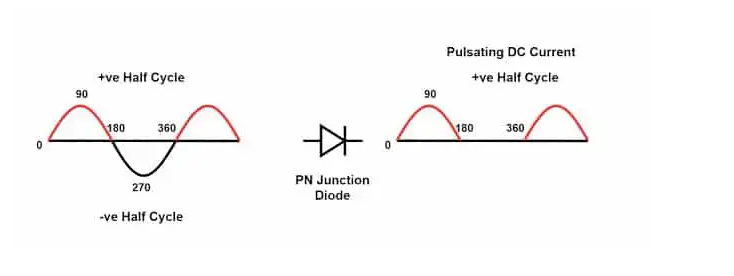
A half-wave rectifier is an essential component in the conversion of alternating current (AC) to direct current (DC). Unlike a full-wave rectifier that uses both halves of the AC cycle, a half-wave rectifier utilizes only one half. This process involves converting the AC signal's positive or negative half cycles into a pulsating DC signal, thereby "rectifying" it.
In simple terms, a half-wave rectifier blocks one half of the AC signal, allowing only the other half to pass through. This rectification process is crucial in various electronic devices where DC power is required. These formulas help in understanding and designing half-wave rectifier circuits, ensuring they meet the required specifications for various applications.
Half Wave Rectifier Circuit
A Half Wave Rectifier Circuit is relatively simple and consists of a few key components:
AC Supply: Provides the input AC voltage.
Transformer (optional): Steps up or steps down the AC voltage to the required level.
Diode: The core component that allows current to flow in only one direction, thus rectifying the AC signal.
Load Resistor (R_L): The component across which the output DC voltage is obtained.
Circuit Diagram of Half Wave Rectifier
The circuit diagram of a half-wave rectifier can be depicted as follows:
In this diagram:
The AC input is connected to the primary winding of the transformer.
The secondary winding of the transformer is connected to the diode.
The anode of the diode is connected to the secondary winding, and the cathode is connected to the load resistor RLR_LRL.
The output DC voltage is taken across the load resistor.
Working Principle of Half Wave Rectifier
The working principle of a Circuit Diagram of Half Wave Rectifier is straightforward:
During the positive half cycle of the AC input, the diode becomes forward-biased, allowing current to pass through. This results in a positive voltage across the load resistor.
During the negative half cycle, the diode is reverse-biased, blocking current flow. Consequently, no voltage appears across the load resistor during this half cycle.
As a result, the output voltage consists of only the positive half cycles of the AC input, creating a pulsating DC signal.
Applications of Half Wave Rectifier
Despite its simplicity, the half-wave rectifier finds numerous applications, particularly in low-power and cost-sensitive scenarios. Some common applications include
Power Supplies: Used in basic power supplies to convert AC to DC for small electronic devices.
Signal Demodulation: Employed in radio receivers and other communication devices to extract the modulated signal from the carrier wave.
Voltage Multipliers: Used in voltage multiplier circuits to produce high DC voltages from AC sources.
Peak Detector Circuits: Utilized in circuits designed to detect the peak value of the input AC signal.
Testing and Measurement: Serves as a simple method to test and measure the rectifying behavior of diodes and other components.
Also Check :-
Conclusion
The half-wave rectifier, though basic in its construction and operation, plays a vital role in the realm of electronics. By converting AC to DC, it serves as a foundational element in power supplies, signal processing, and various other applications. Understanding the half-wave rectifier's formula, circuit, diagram, and applications equips engineers and enthusiasts with the knowledge to design and implement efficient rectification solutions.
At Electrical Volt, we are committed to providing high-quality rectification components and solutions that meet the diverse needs of our clients. Whether you are looking to power a small device or develop sophisticated electronic systems, our expertise in rectification technology ensures reliable and efficient performance.

